

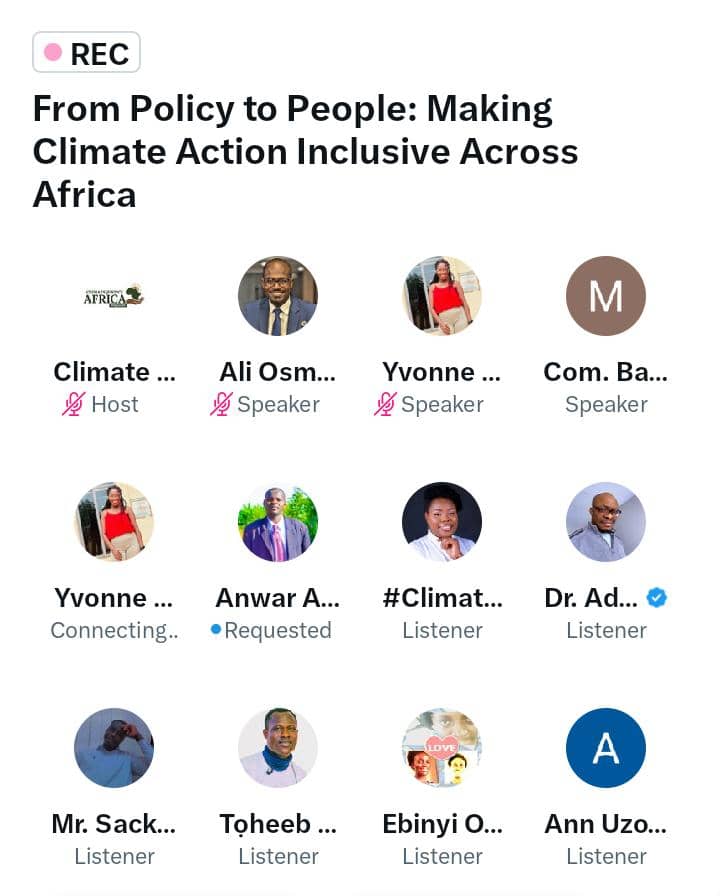
Climate justice in Africa is no longer a question of whether policies exist, but whether those policies work for the people most affected by climate change. This central tension shaped Climate Justice Africa Magazine’s X Space conversation held on January 9, 2026. The discussion brought together legal, inclusion, and media perspectives to interrogate why climate action often fails at the grassroots level despite strong global and national commitments.
The session featured Barrister Okoroafor Okechukwu (Nigeria), who examined governance and policy implementation gaps; Ali Osman Ali Ibrahim (Sudan), who focused on inclusion, indigenous knowledge, and vulnerable populations; and Rim Ben Khalifa (Tunisia), an environmental journalist whose media-focused contribution was submitted in advance due to technical challenges.
Moderated by Yvonne Yemoh, the conversation deliberately shifted attention from high-level climate rhetoric to the realities of communities across Africa, where climate impacts are lived daily but policy responses remain distant.
Opening the conversation, Joy Ify Onyekwere, Founder of Climate Justice Africa Magazine, framed the discussion around the urgent need to close the gap between climate policy and lived realities across Africa. She emphasized that while policies and global commitments continue to expand, climate action remains distant for many farmers, women, youth, informal workers, and rural and coastal communities. She underscored that climate justice must deliver tangible benefits as she reaffirmed the Magazine’s mission to amplify African voices and ensure inclusion, justice, and local realities remain central to climate action, setting the tone for an open, solution-focused dialogue.
Climate Policy and the Governance Gap at the Local Level
Barrister Okoroafor Okechukwu opened the conversation by drawing attention to what he described as the “missing foundation” of climate governance in Africa: local government systems. He argued that while climate laws and frameworks exist at global and national levels, they are nearly absent where implementation truly matters; at the community level.
He likened the situation to “a building without a solid foundation,” noting that local governments often lack clear constitutional authority, defined climate mandates, budgetary allocations, and technical capacity to implement climate actions. As a result, policies remain theoretical documents rather than living tools for resilience.
Barrister Okechukwu emphasized that Africa’s climate challenges are not uniform. Coastal communities face rising sea levels, inland regions struggle with desertification, and pastoral areas contend with shrinking grazing lands. Yet, decision-making remains centralized, producing one-size-fits-all solutions that fail to reflect local realities.
Crucially, he pointed out that grassroots voices are systematically excluded from policy formulation, leading to weak ownership and poor compliance. Traditional governance systems, such as town unions, community elders, and informal leadership structures are rarely integrated into climate planning, despite their influence at the local level.
Limited access to finance further compounds the problem. While international mechanisms like the Global Climate Fund exist, Barrister Okechukwu noted that they remain largely inaccessible to local governments and communities due to bureaucratic bottlenecks and the absence of direct funding channels.
He stressed that climate action must be reframed as a governance dividend—one that improves health outcomes, secures livelihoods, and strengthens community resilience—rather than as an abstract environmental obligation.
Inclusion as a Core Principle, Not an Afterthought
Ali Osman Ali Ibrahim expanded the discussion by asserting that inclusion must be intentionally designed into climate action, not retrofitted after projects are already underway. According to him, many climate initiatives claim inclusivity but fail to set measurable participation targets for women, youth, indigenous people, pastoralists, and persons with disabilities.
He argued that meaningful inclusion requires capacity building, enabling marginalized groups to engage not only at the community level but also in national and international climate negotiations. African countries, he noted, often negotiate as blocs in global forums to amplify their voices, yet the perspectives of the most affected communities are still underrepresented.
Ali highlighted disability inclusion as one of the most overlooked dimensions of climate justice. People with disabilities face disproportionate risks during climate disasters, from heatwaves to floods, yet climate policies rarely account for their specific needs. He called for tailored disaster response plans and inclusive education systems that integrate children with special needs using appropriate tools and support structures.
In his view, inclusion shifts climate action from a model of “doing for communities” to “doing with communities.” This approach fosters partnership, dignity, and long-term sustainability rather than dependency.
Indigenous Knowledge: Africa’s Undervalued Climate Asset
A recurring theme throughout the conversation was the critical role of indigenous and local knowledge. Ali Osman stressed that Africa’s traditional environmental practices represent one of the continent’s strongest tools for climate adaptation, yet they remain undervalued in formal climate planning.
He called for indigenous knowledge to be treated as legitimate data, integrated into climate research, mapping, early warning systems, and monitoring frameworks. Early engagement with communities, he argued, allows policymakers to translate lived experiences into actionable strategies.
Participants warned against culturally insensitive interventions, such as tree-planting initiatives that ignore local ecosystems or livelihoods. Climate solutions, they agreed, must be co-created, not imposed.
The conversation also emphasized the importance of preserving cultural heritage and intergenerational knowledge. Archiving indigenous adaptation practices and facilitating cross-regional dialogue within Africa can strengthen collective resilience and reinforce climate identity across the continent.
The Media’s Role: From Transmission to Co-Creation
Although absent from the live discussion, Tunisian environmental journalist Rim Ben Khalifa provided a critical media perspective through her pre-submitted contribution. She argued that media campaigns must move beyond top-down messaging to become participatory and community-driven.
According to Rim, meaningful inclusion begins when communities are given the space to tell their own stories in their own languages. She emphasized the power of community radio, local dialects, oral storytelling, visual formats, and offline dissemination, particularly in areas affected by illiteracy and limited internet access.
She cautioned that climate communication often fails because it presents climate change as a distant global issue rather than a lived local reality. Effective media storytelling, she noted, must link climate impacts directly to health, food security, water access, livelihoods, and migration, making the information both relevant and actionable.
Rim also highlighted the importance of building trust, especially in communities that have historically been excluded from policy processes. Media, she argued, should act as a bridge between policy, science, and everyday experience.
Climate Finance, Capacity Building, and Africa’s Negotiation Power
The discussion further examined the persistent challenges around climate finance and technical capacity. Ali Osman noted that African countries prioritize adaptation because climate impacts are already severe, yet funding commitments from developed nations remain uncertain.
Emerging concerns around loss and damage financing were highlighted, particularly for countries facing irreversible climate harm. Participants stressed that finance mechanisms must be transparent and accessible, with clear pathways for funds to reach grassroots initiatives.
Capacity building emerged as a unifying solution—strengthening local actors’ technical skills, enabling communities to implement projects effectively, and empowering African negotiators to advocate for fair financing at international forums.
Awareness and Education as Long-Term Solutions
Contributors on the call agreed that awareness and education form the foundation of sustainable climate action. The contributors identified awareness as a key priority for 2026, noting that many communities experiencing climate hardship do not recognize the link between their struggles and climate change.
Barrister Okechukwu then reinforced the need for education reform, calling for climate and environmental studies to be integrated into school curricula from primary to tertiary levels. Early exposure, he argued, fosters generational ownership, behavioral change, and respect for indigenous knowledge systems.
Conclusion
The January 9 conversation made one message clear: climate justice in Africa will not be achieved through policy documents alone. It requires empowered local governance, deliberate inclusion, respect for indigenous knowledge, accessible finance, and media that listens as much as it speaks.
By centering community realities and amplifying marginalized voices, Climate Justice Africa Magazine positions itself as a bridge between policy spaces and the people who live with the consequences of climate decisions every day.




No comment