

By Signe Noumbou Eponine
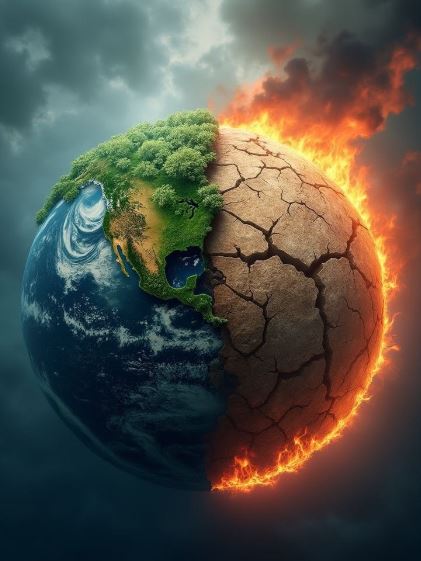
We see the images daily: forests reduced to ash, villages swallowed by rising seas, and cities choked by industrial smog. The physical devastation of the environmental crisis is undeniable[1]. But beneath the surface of these visible scars lies a deeper, more insidious wound, a psychological toll that is increasingly being termed eco-anxiety (chronic fear of environmental doom) and solastalgia (distress caused by environmental change in one’s home environment)[2]. So, recent research in psychology and public health has revealed new mental conditions directly linked to environmental degradation[3][4] and two of the most discussed conditions are eco-anxiety and solastalgia (also known as econostalgia)[5].
While the right to a healthy environment is now recognized by over 150 nations[6], our legal systems remain blind to this silent epidemic. A ground breaking field of legal research is now asking a critical question: In an age of ecological collapse, is the profound mental distress caused by environmental degradation a violation of our fundamental human rights?
Understanding the Invisible Wounds
First coined by philosopher Glenn Albrecht, solastalgia describes the distress we feel when our home environment is negatively transformed. It’s a form of homesickness while still at home[7]. It’s the grief felt by Indigenous communities watching their ancestral forests be cleared, or the despair of farming families whose fertile land has turned to dust due to prolonged drought[8]. Eco-anxiety, on the other hand, is the chronic fear of environmental doom, the pervasive worry about the future in the face of escalating climate news[9]. It’s not a clinical diagnosis but a rational response to a very real and existential threat, particularly acute among the youth[10]. For too long, these experiences have been dismissed as personal anxieties. But as the research shows, they are direct, foreseeable consequences of environmental destruction and government inaction[11]. The legal frontier is now shifting to acknowledge that a “healthy environment” must include mental well-being[12].
The African Paradox: Strong Laws, Silent Suffering
Nowhere is the urgency to address this issue greater than in Africa, a continent disproportionately burdened by climate change despite contributing minimally to its causes[13]. The legal foundations for protection are already in place: The African Charter on Human and Peoples’ Rights enshrines both the right to health[14] and the right to a satisfactory environment[15] Countries like Kenya[16], South Africa[17], and Cameroon[18] have woven these rights into their very constitutions. Yet, as legal scholar notes[19], African jurisprudence has yet to explicitly connect environmental degradation to psychological harm. The focus remains overwhelmingly on physical health and ecological damage. The potential is immense; the Kampala Convention, the African Union’s landmark treaty on internally displaced persons, explicitly includes those displaced by “natural or human-made disasters” and mandates “psychosocial counselling[20]“. This creates a direct legal pathway to address the trauma of communities forced from their lands by climate-driven droughts or floods.
Why, then, the silence in courtrooms? The barriers are significant, proving a direct causal link between a specific polluter and a community’s collective depression[21] is a formidable evidentiary challenge. Furthermore, many governments, focused on rapid economic development, prioritize industrial growth over ecological and psychosocial well-being.
A Global Shift: The Law Catches Up to Reality
While African legal systems grapple with these concepts, the rest of the world is beginning to set powerful precedents[22]; the European Court of Human Rights found that Switzerland’s inadequate climate policies violated the human right to private and family life, explicitly acknowledging the psychological distress caused by the government’s failure to act. This ruling echoes a global trend[23]; In Latin America, the Escazú Agreement[24] includes provisions to protect environmental defenders, whose mental health is often under threat. Even India’s National Green Tribunal has compensated citizens for psychological harm from pollution[25]
These developments create what legal scholars call “soft law”—norms and standards that, while not legally binding, exert significant moral and political pressure. They provide a toolkit for African activists and lawyers to argue that if Europe can protect its citizens from climate-related distress, then Africa must do the same.
The Path Forward: From Recognition to Redress
So, how do we translate this growing awareness into tangible legal protection? The journey involves several key steps:
- Strategic Litigation: Activists and lawyers must bring test cases before African regional courts and national supreme courts. Building on precedents like South Africa case[26] or Nigeria’s Ogoni case[27], new lawsuits can strategically include claims for psychological damages, forcing judges to interpret the right to health and a healthy environment in a more holistic way.
- Integrating Mental Health into Environmental Law: Governments must be pushed to reform Environmental Impact Assessments (EIAs). These crucial regulatory tools currently assess physical damage to air, water, and biodiversity but almost universally ignore the potential psychosocial impacts of projects like mines or dams on local communities.
- Embracing Interdisciplinary Approaches: Lawyers cannot do this alone, they must collaborate with psychologists, public health experts, and climate scientists[28] to build robust, evidence-based cases that can overcome the causation hurdle so, documenting the mental health footprint of environmental destruction is essential[29].
- Learning from Indigenous Wisdom: Concepts like Ubuntu in Southern Africa, which emphasizes our interconnectedness, offer a powerful cultural framework for understanding solastalgia[30]. The law must learn to value the profound connection between cultural identity, mental well-being, and the land, a connection that Indigenous scholars like Kyle Powys Whyte[31] argue has been severed by a long history of colonial and environmental injustice.
Conclusion: A Right to Psychological Well-Being
The fight to have eco-anxiety and solastalgia legally recognized is more than an academic exercise; it is a fight for human dignity in a deteriorating world. As the great Kenyan environmentalist Wangari Maathai reminded us, “Human rights are not things that are put on the table for people to enjoy. These are things you fight for and then you protect.”
The legal recognition of these psychological harms would be a revolutionary step, it would affirm that the trauma of a farmer losing his livelihood to desertification is as real as a physical injury[32], and that the fear of a young activist for her future is a legitimate claim against government inaction[33]. By expanding our understanding of human rights to include protection from environmental mental distress, we can build a legal system that is truly fit for the challenges of the 21st century and ensure that justice encompasses the mind as well as the body[34].
Bibliographic References
- Albrecht, G. (2005). ‘Solastalgia: A New Concept in Human Health and Identity’.
- Boyd, D. R. (2020). Report of the Special Rapporteur on human rights obligations relating to a safe, clean, healthy and sustainable environment. United Nations.
- Clayton, S. (2020). Climate anxiety: Psychological responses to climate change. Journal of Anxiety Disorders.
- Kampala Convention (2009). African Union Convention for the Protection and Assistance of Internally Displaced Persons in Africa.
- Kotzé, L. J. (2022). The Anthropocentric Constitution: A Constitutional Law for the Anthropocene Epoch. American Journal of International Law.
- Mackenzie, A.F.D. (2004). Re-imagining the land, North Sutherland, Scotland. Journal of Rural Studies.
- Teillet, L. (2023). Ecological Distress: Law(s) and Responsibility(ies). Environmental Rights Review.
- Verein KlimaSeniorinnen Schweiz and Others v. Switzerland (2024). European Court of Human Rights.
- Whyte, K.P. (2017). Indigenous Climate Change Studies: Indigenizing Futures, Decolonizing the Anthropocene. English Language Notes.
[1] Moritz E. Wigand1,2,3 , Cristian Timmermann1,4 , Ansgar Scherp5 , Thomas Becker2 , and Florian Steger : Climate Change, Pollution, Deforestation, and Mental Health: Research Trends, Gaps, and Ethical Considerations
[2] Glenn Albrecht, Solastalgia: A New Concept in Human Health and Identity 2005
[3] Laurence Teillet: Are breaches of the Right to a Healthy Environment capable of triggering the Responsibility to Protect in International Law? Exploring the potential of mental health protection as a catalyst Environmental Rights Review 1(1) 2023
[4] Samantha K. Stanley et al., ‘From anger to action: Differential impacts of eco-anxiety, eco-depression, and
eco-anger on climate action and wellbeing’ (2021) 1 The Journal of Climate Change and Health 1, p. 1.
[5] ibid
[6] the UN Human Rights Council’s 2021 resolution 48/13 and the UN General Assembly’s 2022 resolution A/RES/76/300
[7] Mark O’Connell: you can be homesick athome The lockdown revealed an uncanny and alienating version of my surroundings; The New York Times Magazine; 18 Mai 2020
[8] “My biggest fear of climate change is losing everything. Losing our tradition over the weathers, over melting ice,” said one First Nations father, a hunter from Peawanuck, Ontario; The Climate Crisis and First Nations’ Right to Food in Canada October 21, 2020in Chapter 3. Climate Grief, Eco-Anxiety, and Cultural Mourning;
[9] Charlie Kurth; Panu Pihkala Eco-anxiety: What it is and why it matters
[10] Annamaria Lammel : Environmental crises and climate change: Ecoanxiety among young people and the urgent need for a transformative response ; Field Actions Science Reports Special Issue 27 | 2025 Health and the environment: understanding, anticipating and acting in the face of climate change; January 1, 2025; URL:
[11] CHINYERE A.O ; Nnaemeka C.N; Edache B.O; Onouaha P. : Research article : Areview on environmental challenges and responsiveness; Asian journal of science and technology; Vol. 13, Issue, 05, pp12100-12106, Mai, 2022
[12] Stockholm Declaration (Declaration of the United Nations Conference on the Human Environment), 1972, UN Doc. A/Conf.48/14/Rev.1.
[13] MO IBRAHIM FOUNDATION : The Road to COP27: Making Africa’s Case in the Global Climate Debate; FORUM REPORT, JULY 2022
[14] Article 16 of The African Charter on Human and Peoples’ Rights
[15] Article 24 of The African Charter on Human and Peoples’ Rights
[16] Article 42 of the Constitution of Kenya
[17] Sect. 24 of the Constitution of South Africa
[18] Preamble of the Constitution of Cameroon
[19] Kotzé, L. (2019): Environmental Law and Governance in Africa.
[20] Article 3(1)(e) of KAMPALA CONVENTION African Union Convention for the Protection and Assistance of Internally Displaced Persons in Africa protects against “displacement by any act, event, factor, or phenomenon of comparable gravity”
[21] Kamaldeep Bhui, Joanne B Newbury , Rachel M Latham, Marcella Ucci, Zaheer A Nasir, Briony Turner, Catherine O’Leary, Helen L Fisher, Emma Marczylo, Philippa Douglas, Stephen Stansfeld, Simon K Jackson , Sean Tyrrel, Andrey Rzhetsky, Rob Kinnersley, Prashant Kumar, Caroline Duchaine, Frederic Coulon : Air quality and mental health: evidence, challenges and future directions; 2023 Jul 5;9(4):e120. doi: 10.1192/bjo.2023.507
[22] In a landmark 2024 ruling, the European Court of Human Rights decided the case of KlimaSeniorinnen Schweiz v. Switzerland.
[23] The United Nations Special Rapporteur on Human Rights and the Environment released a report in 2023 urging states to address the psychosocial impacts of the ecological crisis.
[24] Article 9 of the Escazú Agreement focuses on safety from violence, intimidation, and criminalization, the provided text does not explicitly detail provisions for protecting defenders’ mental health. However, by addressing the root causes of threats—such as violence and a lack of support, the Agreement indirectly supports mental well-being by creating a more secure environment for these individuals.
[25] Karmapriya Muschött : Human Rights Report The National Green Tribunal of India; University College Stockholm, March 23, 2022 MR4 Human Rights Clinique II
[26] South Africa: Youth-Led Climate Justice Triumphs in African Climate Alliance & Others v. Minister of Mineral Resources and Energy & Others : the High Court of South Africa delivered a landmark judgment declaring the government’s plan to add 1,500 MW of coal-fired power to the national grid ‘unlawful and invalid’. This ruling came as a result of the ‘Cancel Coal’ case, a youth-led legal challenge spearheaded by the African Climate Alliance (ACA), Vukani Environmental Justice Movement in Action (VEM), and the Groundwork Trust: 4 December 2024,
[27] The African Commission’s decision in Social and Economic Rights Action Center (SERAC) v. Nigeria (2001) (the Ogoni case): While it focused on physical health and displacement, the reasoning—that the Nigerian government’s failure to regulate oil companies violated the right to health (Art. 16) and the right to a “satisfactory environment” (Art. 24)—can be extended by analogy to encompass mental well-being (The mental anguish of the Ogoni people was implicit in the case.
[28] Panu Pihkala : Anxiety and the Ecological Crisis: An Analysis of Eco-Anxiety and Climate Anxiety; September 2020 12(19) DOI:10.3390/su12197836
[29] Carlos Corvalan, Brandon Gray, Elena Villalobos Prats, Aderita Sena, Fahmy Hanna, Diarmid Campbell-Lendrum : Mental health and the global climate crisis; Epidemiol Psychiatr Sci
. 2022 Dec 2; 31:e86. doi: 10.1017/S2045796022000361
[30] Wilfred Lunga, Mkhokheli Sithole, Eugene Nawanti Kombaté, Tendayi Marovah : Integrating Ubuntu: embedding African philosophy into disaster risk reduction and management; Front. Sociol., 03 September 2025
Sec. Sociological Theory, Volume 10 – 2025 | https://doi.org/10.3389/fsoc.2025.1637051
[31] Whyte, K.P. (2017). Indigenous Climate Change Studies: Indigenizing Futures, Decolonizing the Anthropocene. English Language Notes.
[32] Dumisani Shoko Kori : The psychosocial impact of climate change among smallholder farmers: a potential threat to sustainable development; 2023 Apr 26; 14:1067879. doi: 10.3389/fpsyg.2023.1067879
[33] Sara Wilf, Aditi Rudra, Laura Wray-Lake : “I Will Still Fight for It till the End”: Factors That Sustain and Detract from Indian Youths’ Climate Activism; 19 August 2024, the Special Issue Youth Sociopolitical Action: Costs, Benefits, and Supporting Sustainable Sociopolitical Practices, Youth 2024, 4(3), 1238-1259; https://doi.org/10.3390/youth4030078
[34] Rebecca Bratspies : Do We Need A Human Right to a Healthy Environment? SANTA CLARA JOURNAL OF INTERNATIONAL LAW 31 (2015)



No comment