

By Ify Onyekwere
Between 2014 and 2024, Nigeria lost an alarming 134,000 hectares of humid primary forest, some of which are the country’s most ecologically valuable and climate-sensitive locations. This number accounts for 13% of the total tree cover loss recorded during the same period, according to data from global forest watch.
Losing this forest, which are important for clean air, steady rainfall, and healthy soil, means more heat, less rain, and fewer animals and plants.
One of the implication of this 7.1% drop in Nigeria’s forest is that trees are being cut down in areas that are almost impossible to grow back, making it dangerous for local communities that depend on the forest for food, herbs, and protection from extreme weather.
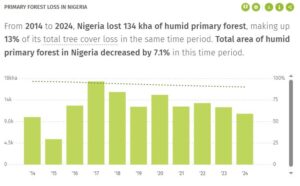
Forest loss from 2014 – 2024
Public Attitudes and Economic Pressures Fuel Tree Loss
Factors such as increased logging to drive economic activities have been mainly attributed to this loss. This is happening amidst a call for increased afforestation to balance rising temperatures, protection and conservation of biodiversity.
Despite the growing threats of climate change, many Nigerians continue to underestimate the critical role trees play in environmental stability. In Abuja, resident Emmanuel Ekpa noted that homeowners often opt for ornamental flowers over trees, particularly in residential and street areas. “Most times, we prefer to plant flowers instead of trees,” he said. “These trees can damage houses, especially when planted too close.”
For others like Grace Edoh, the issue is not a lack of awareness but limited opportunity. While she acknowledges the ecological importance of trees for symbiotic living, she admits she has never actively participated in any tree-planting initiative.
Gaps in Nigeria’s Legal Framework
The existence of national environmental laws such as the NESREA Act, Nigeria’s forests continue to vanish due to weak enforcement, legal gaps and conflicting jurisdiction between federal and state authorities and lack of a unified National Forest Act.
Although Section 27 of the NESREA Act shows penalties for environmental violations, these sanctions are low when weighed against the lucrative profits from deforestation.
Perhaps the law treating such grievous offences with kid gloves does not scare perpetrators.
Findings have shown that the absence of a unified National Forest Act means Nigeria relies on outdated, obsolete or inconsistent laws for forest governance, some of which date back to colonial rule.
These laws do not reflect the current realities of the commercial value loggers get from the sale of trees as well as the environmental effects of their activities.
Meanwhile, countries as India, Brazil, Ghana have clear, centralised laws that govern forest protection, use, and enforcement across their territories. Their laws give consistency, legal clarity, and strong enforcement frameworks.
Fragmented Governance and Weak Oversight
Nigeria’s forest governance is fragmented; forest land is largely under state control, while federal oversight is limited to environmental standards enforced by agencies like NESREA, whose mandate does not extend to direct forest management or licensing.
This lack of a cohesive national framework severely hinders Nigeria’s ability to sustainably manage its forests or fulfill its international conservation commitments.
Voices from the Ground: Expert Calls for Reform
These laws do not reflect the current realities as buttressed by Dr. Peter Oru Bette, an Academic Doctor of Climate Change and Sustainable Development.
“We have all the policies, but they are not implemented. In Cross River State for instance, there is the Cross river State Forest Law which is obsolete, it’s about 15 years old and was supposed to be reviewed every 5 years. No effort is done to review it.”
He continued, ” We also have the State Forestry Commission with the responsibility of managing our forest estate” and aledges it’s been turned to a gold mine for those responsible for protecting it.
“The government has turned forestry into an income generating or revenue-based forestry for some few elements, not the state. Local governments like Boki and Akanpa are seriously involved or deprived because that is where the logging or the forest is.”
He said, “Cross River State has about 50% of the remaining forest, no matter how small it is in Nigeria and most of the forest is found in Boki, and the majority of deforestation is taking place in Boki yet, There’s no development in Boki.
He insisted that the deforestation was massively affecting their choice of food. “We don’t have cocoa yam again. We have heavy acid rain, all are consequences of deforestation. And the impact is evident in changing climate, and the consequences are high, resulting to poverty. Now in Cross River State, either you eat garri, rice or indomie”
Dr. Peter alluded that the forests law were more adhered to in the past than now, “before now we have all the forestry, the forest laws and the foresters were working and were not involved in logging and the government has the willpower to implement its policy but today the moment they are going to a commissioner the first thing you do is that you perpetrate legality, how then can those policies exist? How would they work?” He questioned.
Deforestation Driving Loss of Biodiversity
The ongoing massive deforestation on this area has deeply influenced the extinction of animal species as well.
With continues human encroachment into the deep forest, there are high cases of human-wildlife crisis, mostly under reported.
The doctor of climate change explained the with the steady degradation of forest reserves,.most animal have moved towards the mountenous areas for safety.
Community-Led Conservation Offers Hope
“The luck we have in Buki is that our topography is so wonderful that there are some places you cannot farm. There are a few mountains and some surrounding communities, they have a hilling ecosystem that people cannot farm. That’s why you can see the trees can still survive, the monkeys, the elephants, even though we have a serious human-animal crisis.”
He however commended some communal efforts by Biakwan community which has adopted a conservation strategy. “we have some communities also that have some community reserves, like Biakwan. In the Biakwan community, we have 20,000 acres of land which is reserved by the community, nobody’s allowed to go there.”
As Nigeria continues to address the challenges of forest loss,and legal enforcement gaps, stakeholders across sectors are faced with critical questions about the future of the country’s forest ecosystems. The decisions made today will shape the environmental, economic, and social landscape for generations to come.


No comment