


On February 13, 2026, Climate Justice Africa Magazine (CJAM) convened its monthly X Space conversation on a theme that resonates deeply across the continent: “Indigenous Knowledge Systems in Climate Adaptation and Community Resilience.”
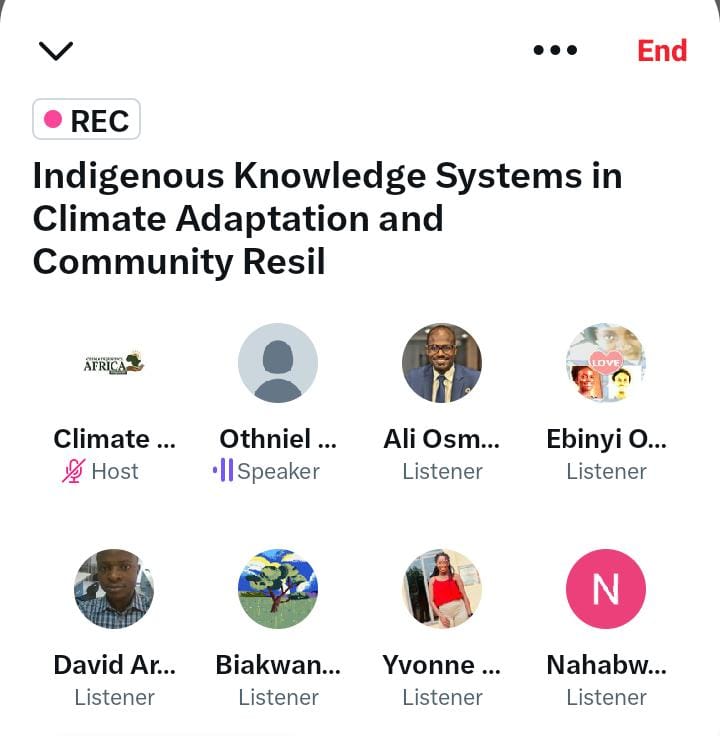
The guest speaker, Dr. Othniel Yila, a distinguished climate finance practitioner with over 25 years of global experience across Africa, the Pacific, and Southeast Asia, delivered a rich and compelling reflection on why Africa must not abandon its ancestral wisdom in the race toward technological climate solutions.
Speaking from Uganda, where he currently serves as the Commonwealth National Climate Finance Adviser, Dr. Yila emphasized that indigenous knowledge did not emerge as a response to climate policy frameworks, it has always existed.
“Indigenous knowledge is something that has been there even before climate change entered policy discussions,” he said. “Africa is a continent that is very rich and well endowed in terms of knowledge.”
Reading the Climate Through Nature
Dr. Yila explained that for generations, African communities relied on ecological indicators to forecast seasonal changes; systems that were precise, interconnected, and locally grounded.
In Uganda’s Teso region, he noted, the flowering of the Erythrina tree historically signaled the onset of long rains. However, farmers now observe the tree blooming nearly three weeks earlier, while rainfall arrives later, creating what he described as a phenological mismatch that disrupts planting calendars.
In Kenya’s drylands, the direction of seasonal winds once reliably predicted rainfall intensity. Meanwhile, the migration of the African woolly-necked stork from South Sudan to wetlands around Lake Victoria traditionally occurred within a predictable 10-day window in March. Today, such patterns have shifted, reflecting broader hydrological disruptions.
“These are not isolated signals,” Dr. Yila explained. “They are interconnected systems.”
The discussion reinforced that indigenous forecasting methods, rooted in biodiversity, wind behavior, bird migration, flowering cycles, and soil texture, remain sophisticated environmental monitoring systems in their own right.
Traditional Risk Management: Africa’s Hidden Resilience
Dr. Yila took participants “back to memory lane,” recalling the devastating 1984–1985 drought in Ethiopia’s Tigray region. Despite the severity of the crisis, communities preserved nearly 30 drought-tolerant varieties of teff and barley through traditional seed storage systems.
Similarly:
In Zimbabwe, the Zunde raMambo granary system, overseen by chiefs, ensured food security during erratic rainfall seasons.
In Ghana’s Ashanti region, sacred groves functioned as watershed protection zones, where tree cutting is traditionally forbidden.
In Uganda and Kenya, pastoralist communities have long maintained grazing preservation systems to cope with prolonged droughts.
“These layered risk management systems existed long before climate adaptation became a policy term,” Dr. Yila said.
However, he acknowledged that such systems now face dual pressures from climate extremes and from the erosion of traditional knowledge transmission.
Technology and Tradition: A Necessary Synergy
One of the central questions raised during the conversation was whether technological innovation and indigenous knowledge are treated as equals in global climate conversations, particularly at COP negotiations.
Dr. Yila affirmed that the global climate governance system increasingly recognizes indigenous communities. Funding proposals under the UN climate framework now require clear articulation of indigenous inclusion and impact.
“Indigenous communities are well recognized,” he stated. “The role they play is very strategic.”
He cited examples from Senegal, where farmers combine satellite seasonal forecasts with traditional plant indicators, and from Malawi, where farmer cooperatives translate scientific data into SMS alerts aligned with local ecological signs.
“Technology can strengthen indigenous systems,” he explained, “not replace them.”
He further referenced the newly operational Loss and Damage Fund, which includes non-economic loss components, such as trauma counselling and cultural recovery, acknowledging that climate impacts are not merely infrastructural but deeply social and psychological.
The Urgent Need to Digitize Indigenous Knowledge
As the session drew to a close, CJAM’s Founder, Joy Ify Onyekwere, asked what younger generations must do to preserve ancestral wisdom.
Dr. Yila’s response was clear: documentation is urgent.
He recounted meeting a young Nigerian digitizing oral histories and environmental knowledge from elders in his community.
“Let us not allow this knowledge to end with some of us,” he urged. “Let us preserve it and pass it on to the next generation.”
He encouraged communities to:
Interview elders and record oral histories,
Create digital archives and community knowledge hubs,
Integrate indigenous systems into climate research and media storytelling.
Digitization, he emphasized, offers durability that paper archives cannot guarantee.
CJAM’s Commitment Going Forward
Participants from Nigeria, Ghana, Sudan, and beyond shared observations of shifting rainfall patterns, such as unexpected January rainfall in Lagos during what should traditionally be the Harmattan season.
The conversation underscored a powerful truth: Africa’s climate resilience will not come from technology alone, nor from tradition alone, but from a deliberate, respectful synthesis of both.
As Climate Justice Africa Magazine continues to spotlight African-led climate solutions, this X Space conversation marks a renewed commitment to elevating indigenous voices, not as cultural artifacts, but as living systems of adaptation and resilience.
For Africa’s climate future, the message is clear:
We must innovate forward, without forgetting what has always sustained us.


No comment