
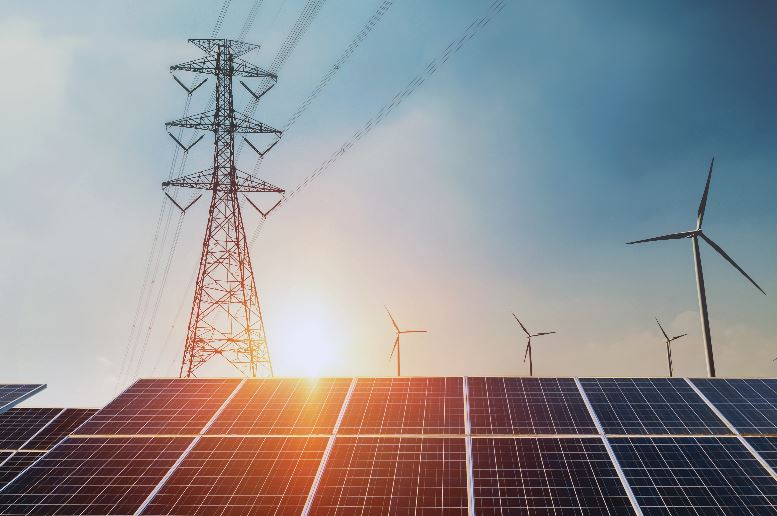
Clean power, stronger grids and coordinated investment must advance together to reduce fossil fuel dependence, the agency’s 2026 analysis finds.
By CJAM News Desk
Electricity could meet about half of Africa’s final energy consumption by 2050 under a climate pathway outlined by the International Renewable Energy Agency (IRENA), with expanded access, cleaner technologies and stronger infrastructure supporting the continent’s development.
The pathway appears in IRENA’s 2026 publication, Transitioning away from fossil fuels: A roadmap powered by renewables, electrification and grid enhancement. The report argues that expanding renewable generation must be accompanied by changes in how energy is delivered and used across transport, buildings and industry.
Its central message is that renewable power, electricity networks, storage, energy efficiency and electrification need to develop together. Adding generation capacity without adequate infrastructure and coordinated planning could leave clean electricity unable to reach consumers reliably.
The figures describe IRENA’s revised 1.5°C Scenario, a modelled pathway consistent with limiting global warming to that level. They are not forecasts of what will inevitably happen or evidence that the required investment has already been secured.
Electricity’s growing role
Under the scenario, electricity’s share of global final energy consumption rises from around 23 per cent to 35 per cent by 2035 and more than 50 per cent by 2050.
Final energy consumption refers to energy used by end users, including households, businesses, transport and industry. Electricity’s share of that consumption is different from the proportion of electricity generated from renewable sources.
Electrification means using electricity to provide services that might otherwise depend directly on combustion fuels. Examples include electric vehicles, electric cooking, heating and cooling equipment, and certain industrial processes.
IRENA explains that electric technologies can deliver energy services more efficiently than combustion-based alternatives by avoiding some conversion losses. When supplied with renewable electricity, they can also reduce dependence on fossil fuels.
However, the report stresses that the power sector must transform alongside electricity demand. Otherwise, switching vehicles, buildings or factories to electricity risks transferring emissions to power generation rather than eliminating them.
Africa’s development opportunity
IRENA’s regional analysis places electricity’s share of Africa’s final energy consumption at 12 per cent in 2023, increasing to 26 per cent in 2035 and about half by 2050 under the scenario.
These percentages measure electricity’s contribution to energy use. They do not represent the proportion of Africans with access to electricity.
The distinction matters because electrification in developing economies involves more than replacing existing fossil fuel technologies. It also supports access to modern energy services, industrial development and growing demand from infrastructure and urbanisation.
IRENA identifies off-grid renewable electricity as an important means of extending access in remote areas. Across much of Africa, it recommends integrated planning that combines centralised generation with distributed solutions, rather than treating national grid expansion as the only route.
The agency also highlights regional electricity trade and stronger interconnections. These can help countries share resources, overcome infrastructure constraints and use renewable generation more efficiently.
National circumstances remain central. Resource availability, economic structure, institutional capacity and investment conditions will shape the pace and form of each country’s transition.
The scale of investment required
The report estimates that global installed renewable power capacity would need to reach approximately 18.4 terawatts by 2035 and 38.2 terawatts by 2050 under its revised scenario.
Electricity networks would require substantial investment alongside that expansion.
Average annual global grid investment would need to rise from approximately US$500 billion in 2025 to around US$1 trillion during 2026–2035, followed by US$1.2 trillion annually during 2036–2050.
IRENA puts cumulative grid investment needs at approximately US$29 trillion over 2026–2050. This is a global infrastructure requirement under the scenario, rather than an African funding allocation or an announced financing package.
Storage must expand too. The report’s projections increase installed global storage capacity from 416 gigawatts in 2025 to 2,530 gigawatts in 2035 and 6,859 gigawatts by 2050. These totals include batteries, pumped hydropower and long-duration storage.
IRENA calls for financing instruments that reduce investment risks and attract private capital, alongside concessional finance, grants and other mechanisms to support developing countries.
Why grids cannot wait
A mismatch between the development timelines of renewable projects and electricity networks is a major implementation challenge.
Renewable generation can be deployed relatively quickly, while grid projects often require longer planning, permitting and construction periods. Without coordination, that gap can delay connections and limit the use of available clean power.
IRENA warns that inadequate grid investment can contribute to congestion, higher costs, reliability problems and curtailment—the reduction of electricity generation when the system cannot accommodate it.
Its recommendations include anticipatory investment, stronger transmission and distribution networks, digital monitoring and better use of existing infrastructure.
The report also emphasises demand flexibility: enabling some electricity consumption to shift in response to system conditions. Coordinating flexible demand with renewable supply can help manage pressure on networks and support reliability.
Changes across homes, transport and industry
Buildings have the highest electricity share among the major end-use sectors in IRENA’s scenario, reaching around 55 per cent in 2035 and more than 75 per cent by 2050.
The transition includes electric appliances, cooking, water heating, heat pumps and growing demand for cooling, supported by efficiency improvements.
In industry, electricity’s share rises to around 35 per cent in 2035 and more than 40 per cent by 2050. Opportunities include electrifying suitable low- and medium-temperature processes, while green hydrogen can support some applications that are harder to electrify directly.
Transport experiences particularly rapid growth from a low starting point, reaching around 15 per cent electrification in 2035 and more than 45 per cent by 2050.
Nevertheless, IRENA does not present direct electrification as a complete solution for every activity. Sustainable fuels remain important for applications such as aviation, while some fossil fuel use persists in the scenario.
Putting fairness into implementation
The report recommends transition strategies that protect affected workers, communities and regions through skills development, social protection and economic diversification.
For economies dependent on fossil fuel exports, IRENA identifies challenges from changing demand alongside opportunities to participate in emerging clean energy value chains.
It also calls for coordination across energy, transport, industry, buildings, finance and planning institutions. Electricity demand, renewable supply, infrastructure, workforce capabilities and public financing must be planned together.
Progress should be assessed through more than installed generation capacity. IRENA proposes tracking electricity’s share of final energy use, technology deployment, grid investment, financing access and socioeconomic outcomes.
For Africa, the report presents renewable electrification as a pathway connecting climate action with development. Realising that opportunity will depend on translating global ambitions into nationally appropriate investments that deliver reliable energy services, support productive activity and include communities in the benefits.
Source: IRENA (2026), Transitioning away from fossil fuels: A roadmap powered by renewables, electrification and grid enhancement, International Renewable Energy Agency, Abu Dhabi. Key material: pp. 6–7, 15–29 and 30–33.






No comment