
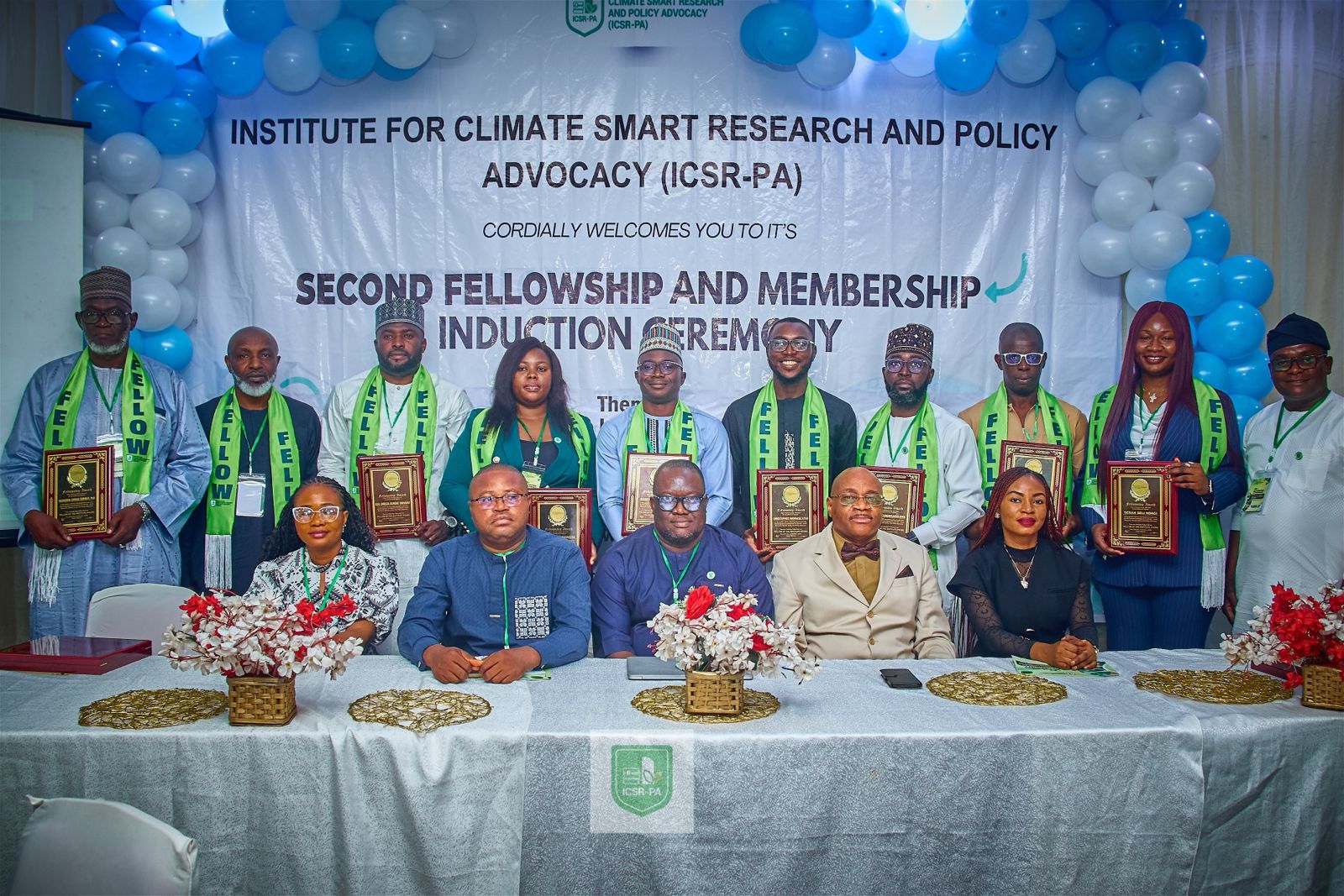
At its second induction ceremony in Abuja, the institute highlighted professional responsibility, community ownership and measurable results as essential to a just climate transition.
The Institute for Climate Smart Research and Policy Advocacy (ICSR-PA) has inducted fellows and members, with a call for climate action that protects livelihoods, strengthens institutions and gives communities a meaningful role in decisions affecting their future.
The second induction ceremony, held on Tuesday, 27 October 2026, in Abuja, brought together participants attending in person and online. Presentations examined how Africa can reduce emissions and build resilience while expanding energy access, creating jobs and addressing inequalities.
Climate responsibility across professions
Delivering a presentation titled Decarbonisation and Climate Resilience in Africa: The Role of Professionals, Institutions and Communities, the institute’s Registrar General and Chief Executive Officer, Sir Richard Akase Inyamkume, stressed that climate action extends across professional practice, institutional governance and community life.
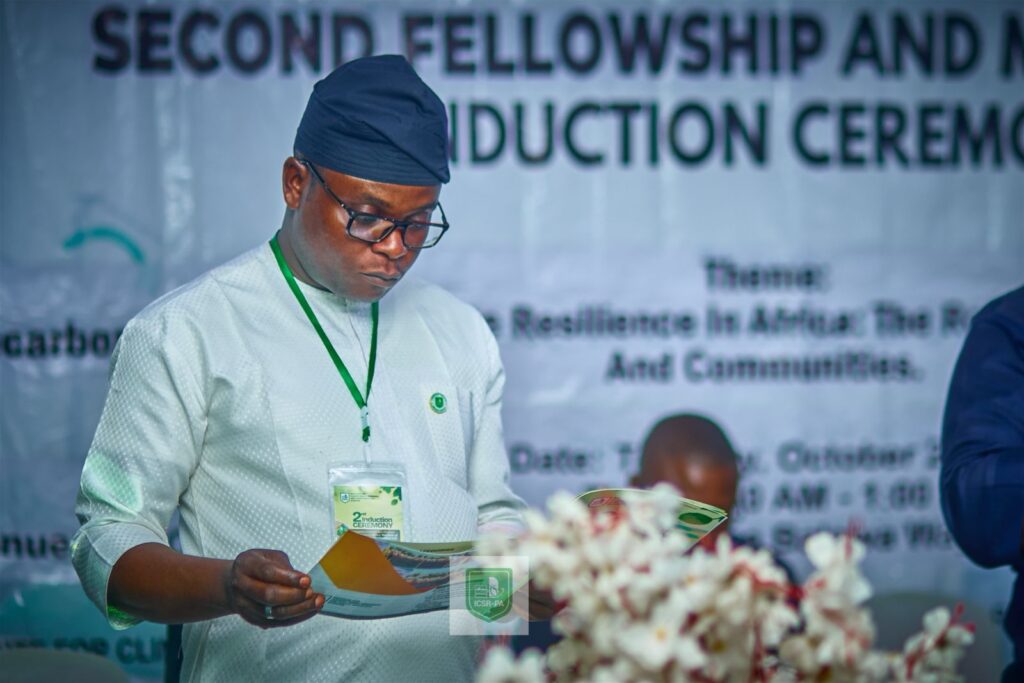
ICSR-PA’s Registrar General and CEO, Sir Richard Akase Inyamkume
He described Africa’s climate challenge as a question of transforming how the continent produces, consumes, invests, builds and develops. His presentation connected that transformation to three interdependent actors: professionals whose decisions shape development, institutions that establish policies and allocate resources, and communities whose knowledge and participation influence whether solutions succeed.
Sir Inyamkume urged professionals to examine the climate implications of their everyday decisions. These include the infrastructure engineers design, the activities financial institutions support and the products procurement officers select.
The responsibility, he explained, involves understanding how professional choices affect emissions and vulnerability, identifying who benefits and who bears the risks, and establishing how results will be measured.
A transition that protects livelihoods
Sir Inyamkume placed social responsibility at the centre of decarbonisation, drawing attention to workers, households and communities whose livelihoods may be affected by changes in energy and production systems.
His presentation identified reskilling, alternative livelihoods and fair access to clean energy as important considerations in Africa’s transition. It also highlighted the need to assess how costs and benefits are distributed, including the different effects on women, young people and marginalised groups.
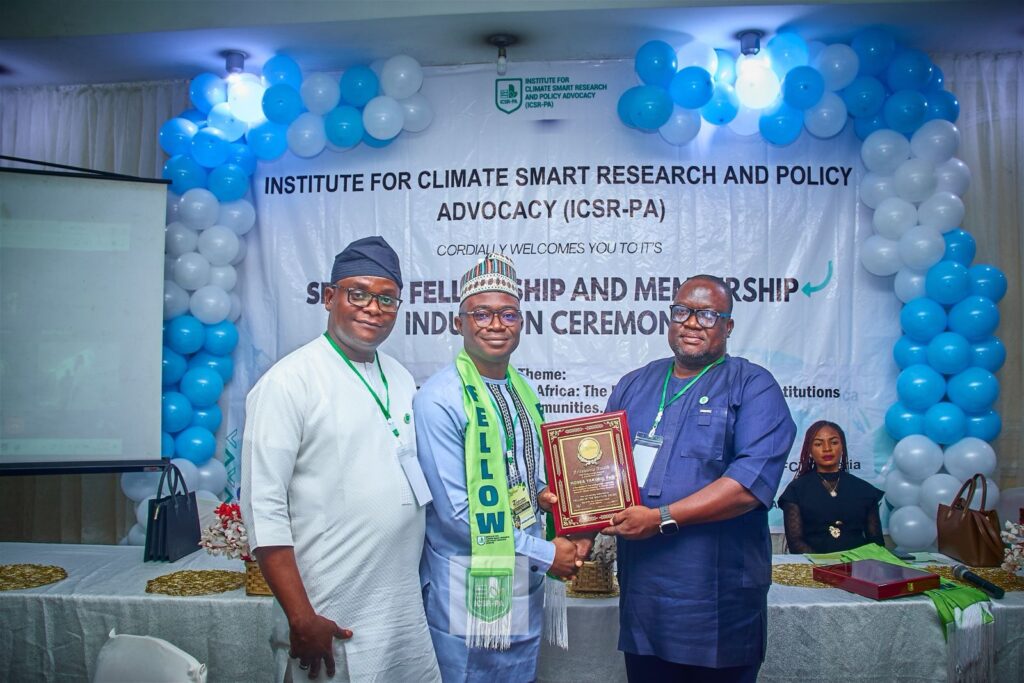
Receiving of awards
The approach connects emissions reduction with wider development priorities. Energy access, industrialisation and poverty reduction must be considered alongside adaptation and ecosystem protection.
“We cannot build resilience while ignoring emissions, and we cannot pursue decarbonisation while ignoring people’s vulnerability,” Sir Inyamkume stated in his presentation.
He also challenged a view of Africa defined solely by climate vulnerability, highlighting the continent’s professionals, local knowledge, entrepreneurs and renewable energy potential as assets for shaping its development.
Communities as partners and owners
Community ownership was a prominent part of Sir Inyamkume’s presentation.
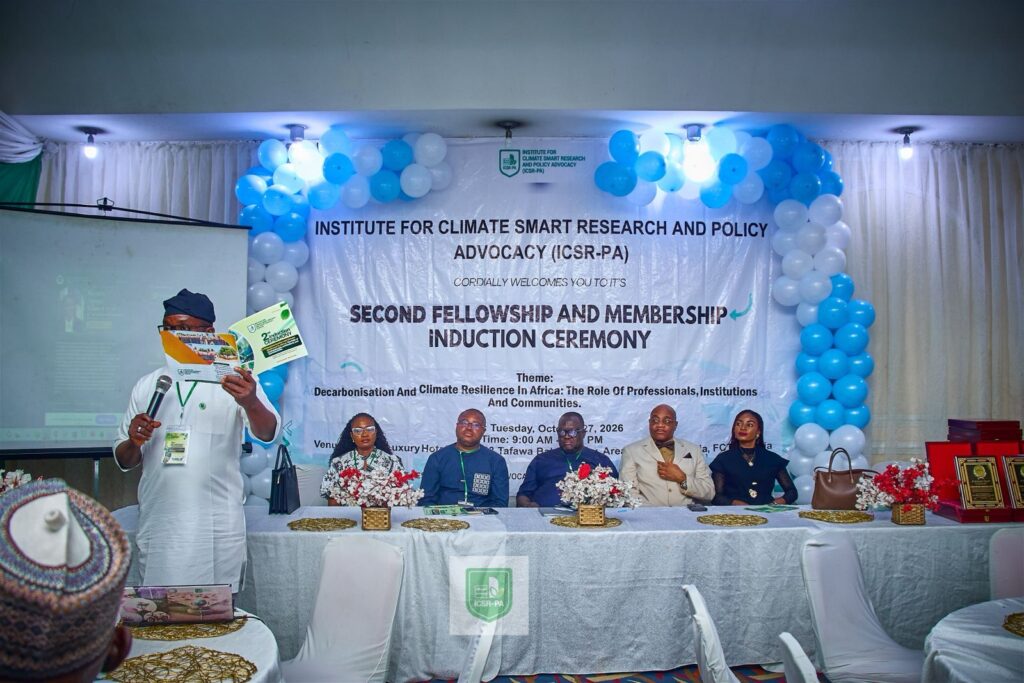
He advocated an approach in which communities help design, implement and monitor interventions, with opportunities to participate in investment and ownership arrangements.
This recognises communities as knowledge holders, innovators and accountability partners. Their involvement can help identify locally appropriate solutions and sustain them after external funding ends.
On climate finance, Sir Inyamkume encouraged scrutiny beyond the total amount available. Important questions include where money goes, who can access and control it, which activities it supports and who ultimately benefits.
He outlined financing options ranging from public investment and concessional funding to green bonds and community finance, while emphasising transparency, accountability and local relevance.
For institutions, he called for climate considerations to be embedded in strategy, budgeting, procurement and operations. His proposed framework involved assessing risks and emissions, aligning policies and resources, implementing interventions, measuring results and applying lessons.
Connecting climate goals with delivery
Building on these issues, Kerstin Apaga-Udasco, a Germany-based sustainability consultant and founder of U&U Consultants, examined the legal responsibilities and evidence needed to deliver climate commitments.
Her presentation, Climate Governance and Implementation: Global Context, European Union and Nigeria, distinguished between international development goals, legal obligations and achieved outcomes.
She explained that institutions need to identify the status of each policy or legal instrument, determine who is responsible and establish what evidence demonstrates implementation.
The distinction is important when assessing climate projects. Associating an intervention with the Sustainable Development Goals does not establish its impact, while announcing finance does not demonstrate that communities have received a functioning service.
Apaga-Udasco examined Nigeria’s climate and electricity frameworks alongside European approaches, connecting governance requirements with practical project delivery.
Reliable energy and resilient services
Using Nigeria’s Distributed Access through Renewable Energy Scale-up programme, known as DARES, Apaga-Udasco illustrated why funding commitments, achieved electricity access and service quality require separate assessment.
Her presentation highlighted the importance of affordable tariffs, maintenance budgets and operational records. At community level, these help establish whether an installation provides dependable electricity and can remain functional over time.
A health station offered an example of how energy access and adaptation intersect. Solar power can improve supply, but a facility exposed to flooding or extreme heat also needs protection for its equipment, appropriate cooling and emergency arrangements.
Assessing service availability and recovery time after extreme events can show whether an intervention has strengthened resilience.
The example connected climate investment with a tangible public benefit: keeping essential healthcare available during difficult conditions.
Clean cooking also featured in her presentation. She identified sustained use, fuel costs and smoke exposure as important measures, including whether households continue using traditional fuels alongside cleaner alternatives.
These considerations help determine whether an intervention fits household needs and remains affordable after equipment has been distributed.
From induction to professional commitment
Across both presentations, accountability depended on clear responsibilities and evidence of results.
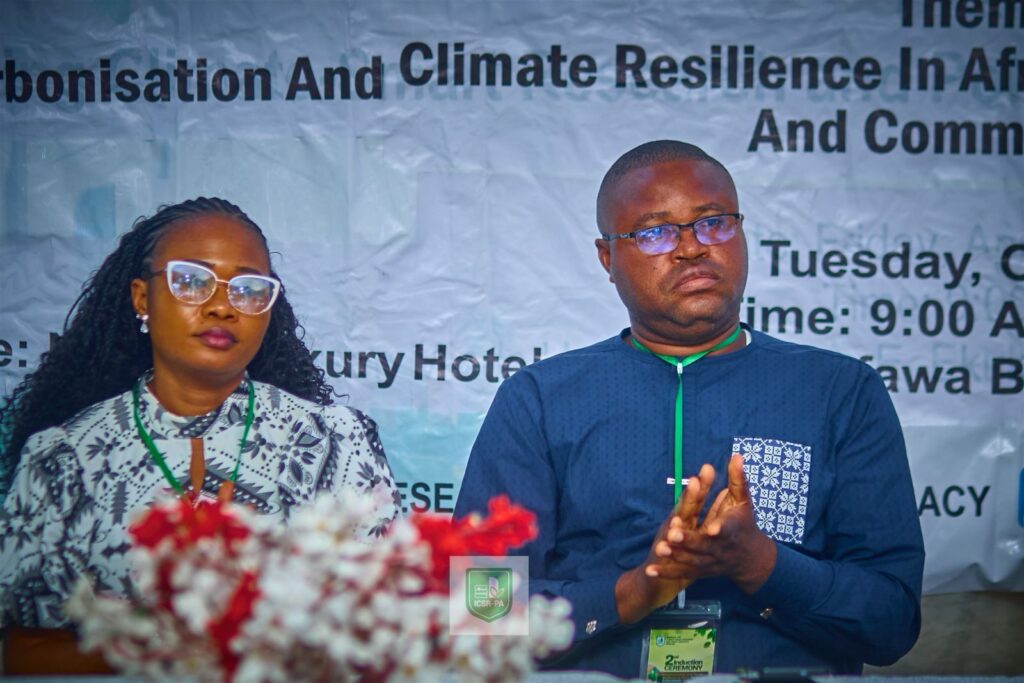
Sir Inyamkume’s emphasis on institutional reform and community ownership was complemented by Apaga-Udasco’s focus on legal requirements, project baselines and performance monitoring. Together, the contributions connected the broader ambition of a just transition with the practical decisions needed to deliver it.
The formal induction brought those responsibilities into focus as fellows took their oath of commitment.

For the newly inducted fellows and members, the ceremony linked professional recognition with the task of applying expertise to climate challenges: helping institutions make informed decisions, supporting community participation and ensuring that climate investment delivers lasting benefits.




What are the modalities of membership